

Framework structure
The key elements of the NMAHP development framework are the:
- Levels of practice
- Pillars of practice
- Knowledge, Skills and Behaviour statements
- Development Needs Analysis Tool
- Framework Reflection Tool
Levels of practice
The levels of practice are based on the Career Framework for Health (Skills for Health 2006; Scottish Government 2009). The levels in the NMAHP & HCSW Development Framework span from level 2 healthcare support worker to level 8 consultant and reflect role development and progression.
Each level has an overview which describes the attributes and the qualifications expected to practice at this level. Generic knowledge, skills and behaviour (KSB) statements are also included for each level to enable you to benchmark and identify any development needs. The consolidation of existing knowledge and skills, and the acquisition of new ones, are reflected in the incremental nature of the framework levels. The KSBs are arranged under the 4 pillars of practice.
It is worth noting that there is a fundamental difference between the Levels of practice described in the Framework and the pay band you are employed at. The Levels reflect career progression and do not link to the Agenda for Change (AfC) pay bands which are related to remuneration and set by your employer.
Go to the Access the Framework page and you will find more information about which level of practice in the overview section.
Pillars of practice
The Framework is structured around 4 interconnected Pillars of Practice. Namely Clinical Practice, Facilitating Learning, Leadership, Service Improvement/ Evidence, Research and Development. The knowledge, skills and behaviours described in the Pillars are common to all NMAHP professions and specialities.
The Pillars and Levels are designed to work together to highlight the breadth and range of knowledge and skills required to practice safely and effectively for all healthcare professionals.
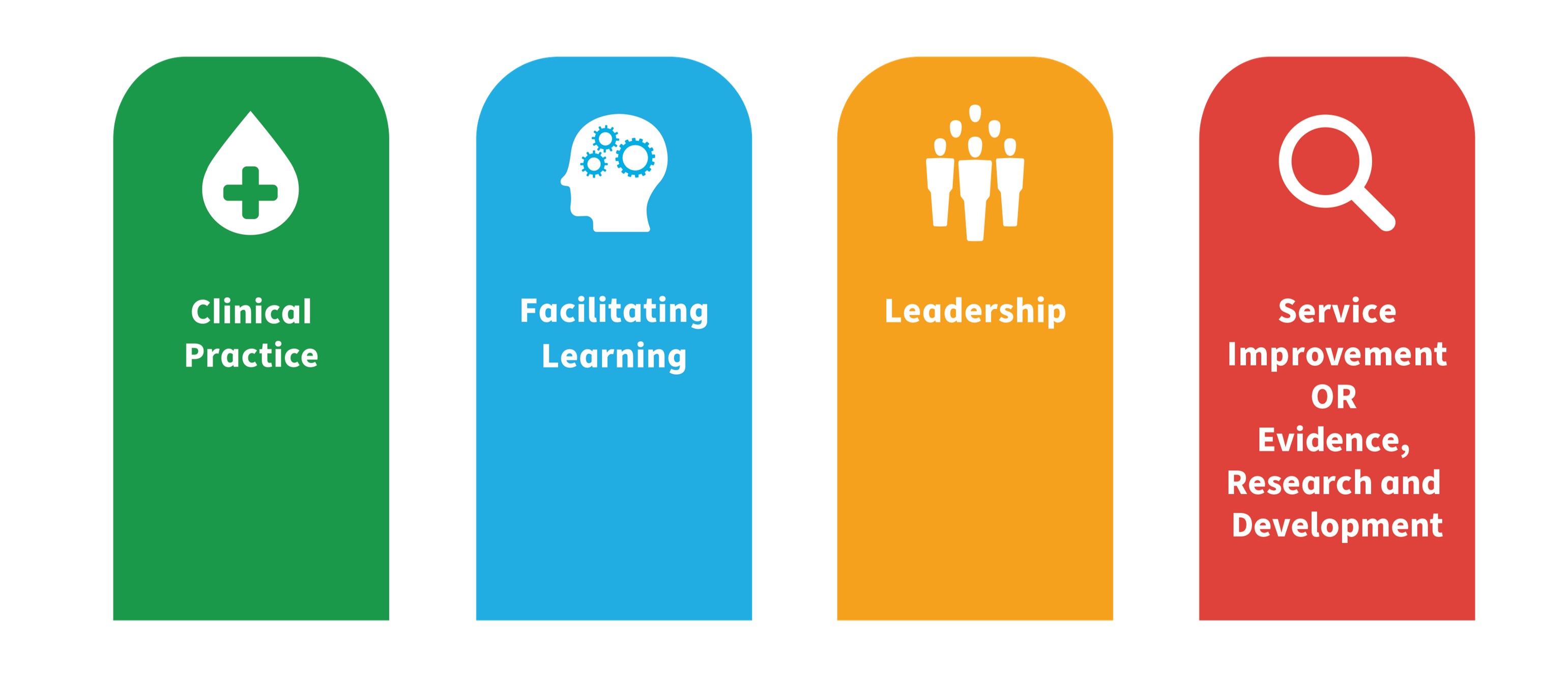
Table 1 gives an overview of the knowledge, skills and behaviours described within each pillar.
| Pillars of Practice | Description |
| Clinical Practice | The knowledge, skills and behaviours needed to provide high quality healthcare that is safe, effective and person centred. |
| Facilitating Learning | The knowledge, skills and behaviours needed to enable effective learning in the workplace |
| Leadership | The knowledge, skills and behaviours needed to lead and to fulfil management responsibilities |
| Service Improvement (Levels 2 to 4) | The knowledge, skills and behaviours needed to use evidence to improve services and practice. |
| Evidence, Research and Development (Levels 5 to 8) | The knowledge, skills and behaviours needed to use evidence to inform practice and improve services |
Using the Pillars
The Pillars are designed to help you look at all aspects of your practice and support your learning and development.
There can be a tendency to focus on the Clinical Pillar initially as the knowledge and skills may feel more relevant and familiar. However, developing skills across the other Pillars can serve to strengthen your clinical skills. The emphasis on each Pillar can vary according to your level of practice and your specific role.
For example, the emphasis may be on the Clinical Practice Pillar for a practitioner at Level 5 whereas at Level 8, the Leadership Pillar may predominate (Figure 1). A practitioner in a specific role, such as a Practice Educator, will give more emphasis to developing the knowledge, skills and behaviours associated with the Facilitating Learning Pillar than a practitioner at the same level working in a clinical role.
Depending on the individual’s role, they may not demonstrate all knowledge, skills and behaviours all of the time, but they should have the capability to do so at their level of practice and all those in the preceding level of practice.
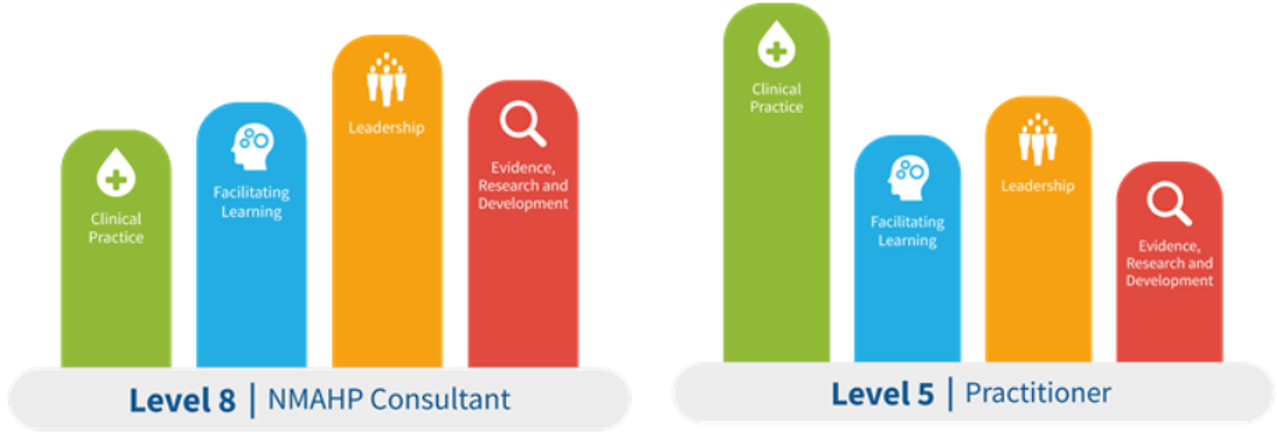
Figure 1

Knowledge Skills and Behaviours
The knowledge, skills and behaviours (KSBs) described in the pillars are common to all NMAHP professions and specialities and can be applied to the specific context in which you work.
The Framework is designed to work in conjunction with other specialist frameworks. The Framework provides the generic/core content, that can be used as the basis from which to add role-specific knowledge, skills and behaviours and the detail associated with a specialism. For example, a practitioner working in a mental health clinical environment may add clinical elements from a specialist mental health framework.
Please note that there are some similarities and overlap of the KSB statements between the Pillars. It is worth keeping this in mind when you are developing your evidence as it may cover several KSBs across the Pillars.
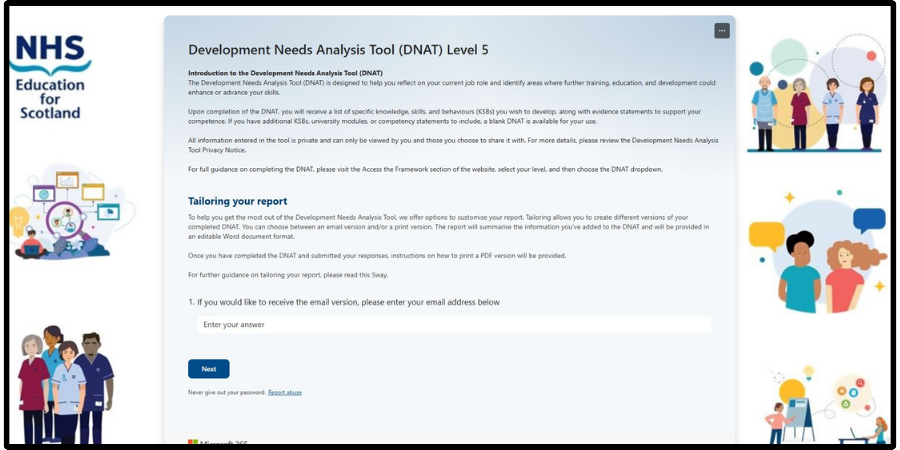
Development Needs Analysis Tool (DNAT)
The Development Needs Analysis Tool (DNAT) is a self-assessment tool that enables you to use the Framework to reflect on your job role and identify areas where you might benefit from further development. The DNAT uses the knowledge, skills and behaviour (KSBs) statements from the Framework which are arranged under the Pillars of Practice to assess your lLevel of practice. There is a DNAT for each corresponding Level of the Framework.
A RAG (Red-Amber-Green) rating scale is used to help you to assess and rate your current knowledge and skills. Like most forms of self-assessment this can feel a bit daunting and challenging. The best approach is to try to be as open and honest as possible when reviewing each KSB.
RAG scale
|
|
|
RED |
I require training and development in most or all of this area. |
AMBER |
I require further training and development in some aspects of this area. |
GREEN |
I am already confident in carrying out this outcome competently. |
As part of the assessment process, you will be asked to provide evidence for the knowledge, skills, and behaviours (KSBs) in which you have rated yourself as proficient.
Your evidence should be clear, concise, and directly relevant to the specific KSB. It should detail your relevant learning and how it is applied in your practice, demonstrating evidence-based and contemporary practice.
You can source evidence from various areas of your practice. Examples include:
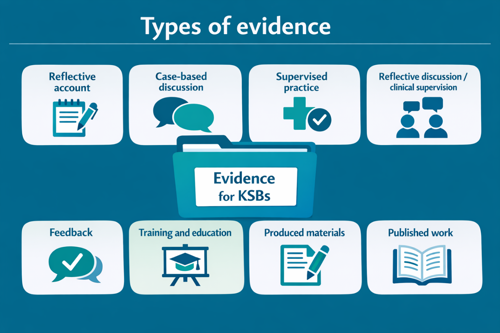
• Reflective Account: Analyse an experience in practice or education, typically around 250 words, using a reflective model such as Gibbs or Schön.
• Case-based discussions: Structured discussion with peer/supervisor of a case to explore key issues, challenges and decision-making processes.
• Supervised Practice: Observations and feedback from your supervisor.
• Reflective Discussion/Clinical Supervision Activity: Document highlights from discussions that demonstrate relevant learning and its application to KSBs.
• Feedback from Colleagues and Service Users: Include feedback that outlines your strengths, areas for improvement, and how these relate to the KSBs.
• Account of Training and Education Undertaken: Provide an explanation of how your self-directed learning is relevant to the KSB.
• Produced Materials: Include case studies, critical reviews, teaching materials, presentations, or reports you have created.
• Published Work: Any relevant publications that support your proficiency.
You may find that a single piece of evidence can address multiple KSBs, even across different pillars, as there are some overlaps in the KSB statements.
You can complete all the pillars at once or individually. If you choose to work on them one at a time, you can save your progress on the MS Form by selecting the submit button at the end of each set of questions. This will send you an emailed report summarising the information you've entered.
After submitting, you can select other pillars to continue your analysis at the end of each set of review questions.
You can individualise the DNAT by adding additional role/profession specific KSBs from other competency or speciality frameworks relevant to your role. There is a blank template for this purpose.
The DNAT can also be used to demonstrate evidence of competency to support advanced level practice local sign-off and ongoing proficiency.
Once completed the DNAT can be used to support reflective discussions and professional development planning with your manager.
The DNAT can be accessed in different formats to suit your learning needs. You can download as a word document, or you can access an online version of the tool. The online version can be saved, printed and sent to a third party. To access the DNAT go to the Access the Framework page and select your level of practice and then go to the Self-Assessment section.
If you’re completing the DNAT in full, it will take a bit of time. Many people find it easier to work through one pillar at a time and save as they go. To save your responses, you’ll need to be signed into your Microsoft 365 account. For more information, please read this guidance.
We have created a step-by-step guide to help you get started with the Development Needs Analysis Tool (DNAT). This guide will walk you through the process, ensuring you can navigate the tool effectively and make the most of your assessment.
Tailor the development needs analysis report to meet your needs.
Tailoring allows you to create different versions of your completed DNAT. You can choose between an email version and/or a print version. The report will summarise the information you've added to the DNAT and will be provided in an editable Word document format.
Once you have completed the DNAT and submitted your responses, instructions on how to print a PDF version will be provided.
For further guidance on tailoring your report, please read this Sway .
Select the Sign Off option/s relevant to you.
You can use the DNAT to support you with your appraisal and professional development review (PDPR) process, while also providing evidence of your ongoing CPD and to evidence working at advanced level for local sign off purposes.
A Sign Off template is built into the DNAT report, allowing you to easily email it to your line manager, practice assessor, or other third parties.
Select which Pillar you would like to review.
You can complete all the pillars at once or individually. If you choose to work on them one at a time, you can save your progress by selecting the submit button at the end of each set of questions. This will send you an emailed report summarising the information you've entered.
After submitting, you can easily select other pillars to continue your analysis at the end of each set of review questions.
Review each KSB and rate your level of confidence using the assessment scale. Give careful thought to your assessment and how you might demonstrate proficiency of the KSBs. Your thoughtful evaluation will help guide your development plan.
Provide a plan to achieve your identified learning need.
This should include:
- Specific steps you will take to address the need
- Resources or support you will utilise
- Strategies for implementation
- A timeline for achieving your goals
You may find the action plan template helpful with this.
Provide evidence of your proficiency.
As part of the assessment process, you will be asked to provide evidence for the knowledge, skills, and behaviours (KSBs) in which you have rated yourself as proficient.
Your evidence should be clear, concise, and directly relevant to the specific KSB. It should detail your relevant learning and how it is applied in your practice, demonstrating evidence-based and contemporary practice.
You can source evidence from various areas of your practice. Examples include:
- Reflective Account:
Analyse an experience in practice or education, typically around 250 words, using a reflective model such as Gibbs or Schön. - Supervised Practice:
Observations and feedback from your supervisor. - Reflective Discussion/Clinical Supervision Activity:
Document highlights from discussions that demonstrate relevant learning and its application to KSBs. - Feedback from Colleagues and Service Users:
Include feedback that outlines your strengths, areas for improvement, and how these relate to the KSBs. - Account of Self-Directed Learning:
Provide an explanation of how your self-directed learning is relevant to the KSB. - Produced Materials:
Include case studies, critical reviews, teaching materials, presentations, or reports you have created. - Published Work:
Any relevant publications that support your proficiency.
You may find that a single piece of evidence can address multiple KSBs, even across different pillars, as there are some overlaps in the KSB statements.
Once you have worked through all the KSBs for a Pillar then you will come to the Pillar summary section. You will now have the choice to submit and save or continue analysis by selecting another Pillar.
At this point, you can use the blank Development Needs Analysis Tool (DNAT) to document any other university modules or competency statements related to the Pillar. You can find the blank DNAT available here .
To submit and save your responses, please ensure you are signed into your Office 365 account.
For more guidance on saving please review this Sway .
Important Note: If you select a Pillar that you have already reviewed or completed, your session will end, and your results will be automatically emailed to you (provided you entered your email address). You can return to previous sections at any time by selecting the BACK button.
To continue your analysis, please select the next Pillar you would like to review.
The next step is to take some time to reflect on your learning needs assessment and complete the action planning and priority rating tool. This will assist you in planning and prioritising your development.
It can also be beneficial to discuss your learning and development needs with your line manager or practice assessor and update your Professional Development Plan (PDP) accordingly.
Your feedback is important to us and will help us to continually improve our resources.
Please complete this survey to let us know what you think, thanks.
Framework Reflective Self-assessment Tool
This reflective self-assessment tool is designed to help you evaluate the knowledge, skills, and behaviours (KSBs) outlined in the Framework for your level of practice. It encourages you to reflect on your job role, identify areas for potential growth, and recognise opportunities for further development.
The 4 Pillars of Practice provide a framework to guide your reflection. For Levels 2 to 4, the pillars include Clinical Practice, Facilitation of Learning, Leadership, and Service Improvement. For Levels 5 to 8, the pillars shift to Clinical Practice, Facilitation of Learning, Leadership, and Evidence, Research, and Development.
If you are new to reflection, there is a helpful guidance section with tips and activities to help you to reflect.
This tool serves as an alternative to the Framework Development Needs Analysis Tool (DNAT).
Once completed the tool can be used to support reflective discussions and professional development planning with your manager. If you are working at advanced level the tool can also be used to support evidence of competence and sign off locally.
The Reflective Self-assessment Tool is in MS Word format and is accessed via a link in the Self-Assessment page of your level. You can download and save this self-assessment tool, allowing you to input directly into the document to complete the required sections. Alternatively, you can print this document and write your response by hand. The tool will take at least an hour or more to complete.